Perhaps the most important thing to understand in watercolor painting is that if you have poor-quality or unsuitable materials in your hands, your path to success will be long and hard. You will feel that nothing works out, and no matter how hard you try, it is all in vain. So I strongly recommend approaching this question with full responsibility!
-
The first and one of the most important things is PAPER!
80% of success depends on paper. I paint only on 100% cotton. It is cotton that lets you achieve the effects we need to get the result. This has been proven by my own experience and that of many other watercolor artists. There is also paper weight. We will use paper with a weight of 300 g/m². This paper holds water well and lets you work on a wet sheet for an optimally long time. I recommend BAOHONG paper.
-
The second, no less important thing is paints!
There is a huge variety of paints. I use different manufacturers and many shades. It all depends on the mood I want to convey in the painting. Very popular in Russia and beyond are the paints from Nevskaya Palitra. They come in pans (solid) and in tubes (soft). I always use tubes because they do not need to be soaked in water beforehand and are much easier to pick up with a brush. To get a dense, beautiful wash, we will use paints in tubes.
-
Next on the list are brushes!
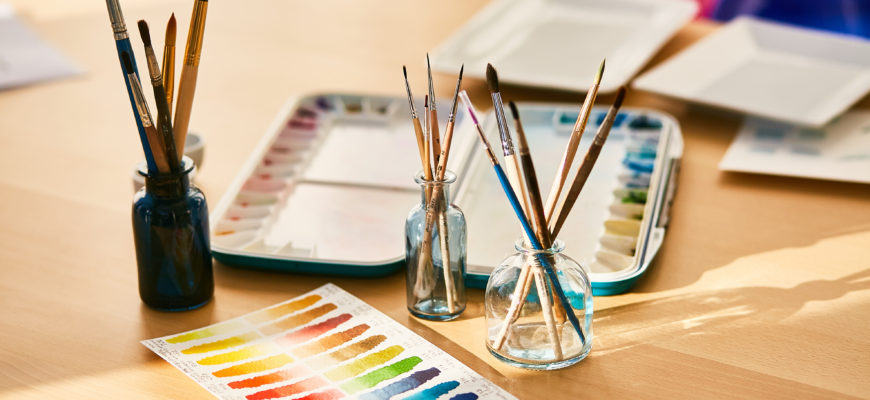
There are even more brushes than paints. They are divided into natural and synthetic, and there are also blends of natural and synthetic fibres. Different types of brushes are used for different purposes. For example, to lay the first wash you need a larger brush that holds a lot of water. And conversely, if you need to paint small details at the end of the work, take a small brush with a fine tip. It is impossible to describe every case — every artist has their own tricks and secrets. I will tell you about the most common ones. For work we will need brushes of different sizes: large, medium and small. The most important thing is that they all have a fine tip when wet. Nevskaya Palitra also has brushes you can choose from for your work. There are also excellent brushes from Roubloff.
-
A palette with paint wells!
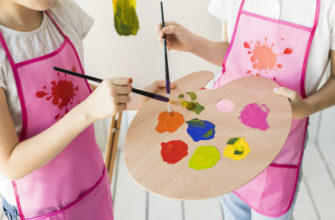
You need a large palette with paint wells (at least 16) in your arsenal. I use a palette from Mijello. Palettes come from different manufacturers. When choosing, pay attention to the size — the bigger the better — and make sure the palette closes tightly. This is important! That way the paints will dry out less and will not leak when you carry it (for example, on a plein air).
-
Kneaded eraser!
There is a type of eraser with a funny Russian name, “klyachka”))) It is an eraser with the consistency of plasticine. It deforms very easily, so you can shape it as you need — for example, roll it into a cylinder. Rolling it over a sheet with a drawing removes excess graphite before the first wash. A kneaded eraser also does not damage cotton paper the way an ordinary eraser can.
-
A simple pencil!
I would say it is not so simple! There is a huge variety of them now, from wooden to mechanical, for every taste and budget. I use a mechanical pencil with replaceable leads. It does not need sharpening and the lead is easy to change (once you get the hang of it)! I use medium-hardness leads so that not much excess pencil is left on the paper.
-
A water container!
You will need a lot of water, and the bigger the container, the longer it will stay (relatively) clean. For plein airs I use a collapsible cup (more about plein airs in another article).
-
And last on the list, but not least, is paper for blotting your brush!
For this you need paper that absorbs water well, such as kitchen paper towels. That is what I use. Some artists use cloth for this. You can choose the option that suits you best.